Kidney

kidney
Chronic diseases, Kidney

Benign Kidney Tumors

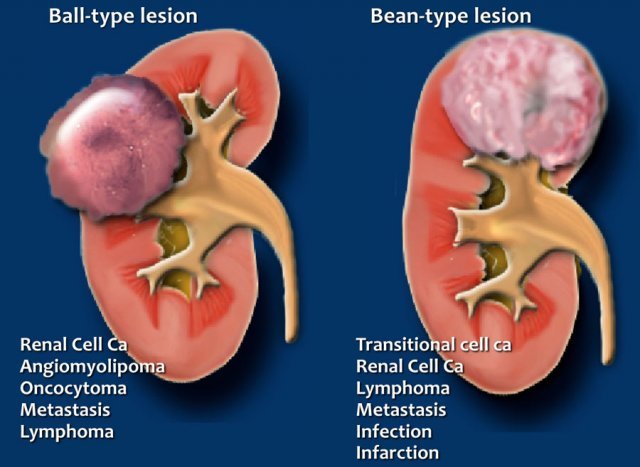
Benign kidney tumors are non-cancerous growths of the kidney that do not spread to other organs but may sometimes mimic malignant tumors clinically and radiologically. Common benign kidney tumors include oncocytoma, angiomyolipoma, and metanephric adenoma. While many are asymptomatic and discovered incidentally on imaging, some may cause symptoms like flank pain, hematuria, or abdominal mass if they grow large. Unlike renal cell carcinoma, these tumors generally have an excellent prognosis, though careful evaluation is necessary to distinguish them from malignant counterparts. Management often involves monitoring (active surveillance), with surgery considered in symptomatic or large tumors.

Benign Kidney Tumors Read Post »

renal medullary carcinoma
Kidney

Renal Medullary Carcinoma (RMC)

Renal medullary carcinoma (RMC) is an extremely rare and highly aggressive subtype of renal cell carcinoma, accounting for less than 1% of kidney cancers. It predominantly affects young individuals of African descent and is strongly associated with sickle cell trait or sickle cell disease. Arising from the renal medulla, RMC often presents late with hematuria, flank pain, weight loss, and a rapidly enlarging renal mass, frequently with widespread metastasis at diagnosis. Prognosis is poor due to its aggressive nature, and treatment options are limited; management may include nephrectomy, chemotherapy, targeted therapy, and immunotherapy, but outcomes remain challenging.

Renal Medullary Carcinoma (RMC) Read Post »

kidney
Chronic diseases, Kidney

Collecting Duct Carcinoma (CDC)

Collecting duct carcinoma (CDC), also known as Bellini duct carcinoma, is a rare and highly aggressive subtype of renal cell carcinoma, representing less than 2% of all kidney cancers. It arises from the epithelial cells of the collecting ducts in the renal medulla. Histologically, it shows irregular tubules and infiltrative growth with a desmoplastic stroma. Clinically, CDC often presents at an advanced stage with symptoms such as hematuria, flank pain, weight loss, and a rapidly enlarging renal mass. Prognosis is generally poor due to early metastasis. Treatment involves radical nephrectomy, but chemotherapy, targeted therapy, and immunotherapy may be considered in advanced cases.

Collecting Duct Carcinoma (CDC) Read Post »

642x361 rcc
Kidney

Chromophobe Renal Cell Carcinoma (chRCC)

Chromophobe renal cell carcinoma (chRCC) is a relatively rare subtype of renal cell carcinoma, accounting for about 5% of cases. It arises from the intercalated cells of the renal collecting ducts and is characterized by large pale cells with prominent cell membranes and perinuclear halos. Compared to clear cell and papillary RCC, chRCC usually has a better prognosis due to its lower metastatic potential. Symptoms are often nonspecific, such as hematuria, flank pain, or an abdominal mass, though many cases are found incidentally. Standard treatment is surgical removal (partial or radical nephrectomy), with systemic therapy considered only in advanced or metastatic disease.

Chromophobe Renal Cell Carcinoma (chRCC) Read Post »

prcc kidney
Chronic diseases, Kidney, Male Health Issues

Papillary Renal Cell Carcinoma (PRCC)

Papillary renal cell carcinoma (PRCC) is the second most common subtype of renal cell carcinoma, representing about 10–15% of cases. It originates from the renal tubular epithelium and is classified into two types: Type 1 (usually less aggressive) and Type 2 (often more aggressive). Microscopically, it is characterized by papillary or tubular structures lined by tumor cells. Risk factors include genetic mutations (such as MET gene alterations), smoking, and chronic kidney disease. Clinically, PRCC may present with hematuria, flank pain, or may be detected incidentally on imaging. Treatment involves surgery, while targeted therapy and immunotherapy are considered in advanced disease.

Papillary Renal Cell Carcinoma (PRCC) Read Post »

normal kidney and cancer kidney illustration
Chronic diseases, Kidney

Clear Cell Renal Cell Carcinoma (ccRCC)

Clear cell renal cell carcinoma (ccRCC) is the most common subtype of kidney cancer, accounting for about 70–80% of renal cell carcinoma cases. It arises from the proximal tubular epithelial cells of the kidney and is characterized by clear cytoplasm due to high lipid and glycogen content. Risk factors include smoking, obesity, hypertension, and certain genetic mutations (notably VHL gene alterations). Clinically, ccRCC may remain silent until advanced, with symptoms such as hematuria, flank pain, or abdominal mass. Diagnosis relies on imaging and biopsy, while treatment involves surgery (nephrectomy), targeted therapy, and immunotherapy.

Clear Cell Renal Cell Carcinoma (ccRCC) Read Post »

wilms’ tumor
Kidney

Wilms’ Tumor (Nephroblastoma)

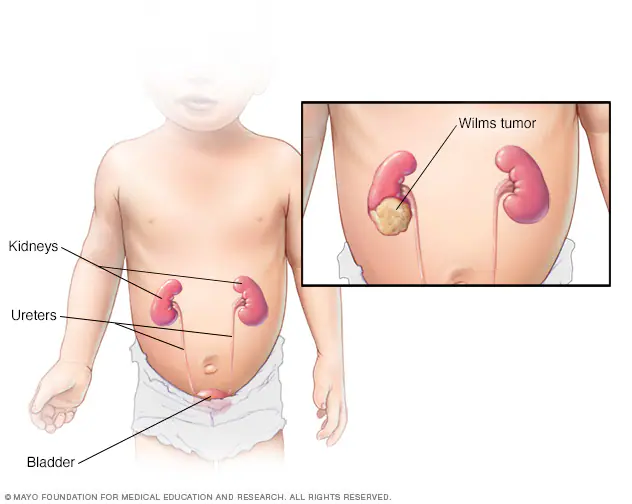
Wilms’ Tumor, also called Nephroblastoma, is a rare kidney cancer that primarily affects young children, usually under the age of 5. It develops from immature kidney cells and often presents as a painless abdominal mass, sometimes accompanied by fever, blood in urine, or high blood pressure. With early diagnosis and modern treatments like surgery, chemotherapy, and radiation therapy, the prognosis is generally favorable. Regular follow-up is important to prevent recurrence and ensure long-term kidney health.

Wilms’ Tumor (Nephroblastoma) Read Post »

kidney cancer
Chronic diseases, Kidney

Kidney Cancer (Renal Cell Carcinoma – RCC)

Kidney cancer, most commonly Renal Cell Carcinoma (RCC), originates in the lining of the kidney’s small tubules that filter blood and produce urine. It often remains silent in early stages and may be detected incidentally on scans. Common symptoms include blood in urine, flank pain, and an abdominal mass, though many cases present late. Risk factors include smoking, obesity, high blood pressure, and genetic predisposition. Early diagnosis through imaging and biopsy improves outcomes, while treatment may involve surgery, targeted therapy, immunotherapy, or a combination depending on stage.

Kidney Cancer (Renal Cell Carcinoma – RCC) Read Post »

female urinary tract (uti)
Chronic diseases, Female Health Issues, Kidney

Urinary Track Infection (UTI) Affecting Kidney – Pyelonephritis

When a urinary tract infection (UTI) spreads to the kidneys, it leads to a condition called pyelonephritis. This infection can cause fever, chills, back or side pain, nausea, and frequent painful urination. If left untreated, it may result in permanent kidney damage or sepsis. Both acute and chronic pyelonephritis can affect kidney function and overall health. Prompt diagnosis with antibiotics and supportive care is essential to prevent serious complications.

Urinary Track Infection (UTI) Affecting Kidney – Pyelonephritis Read Post »